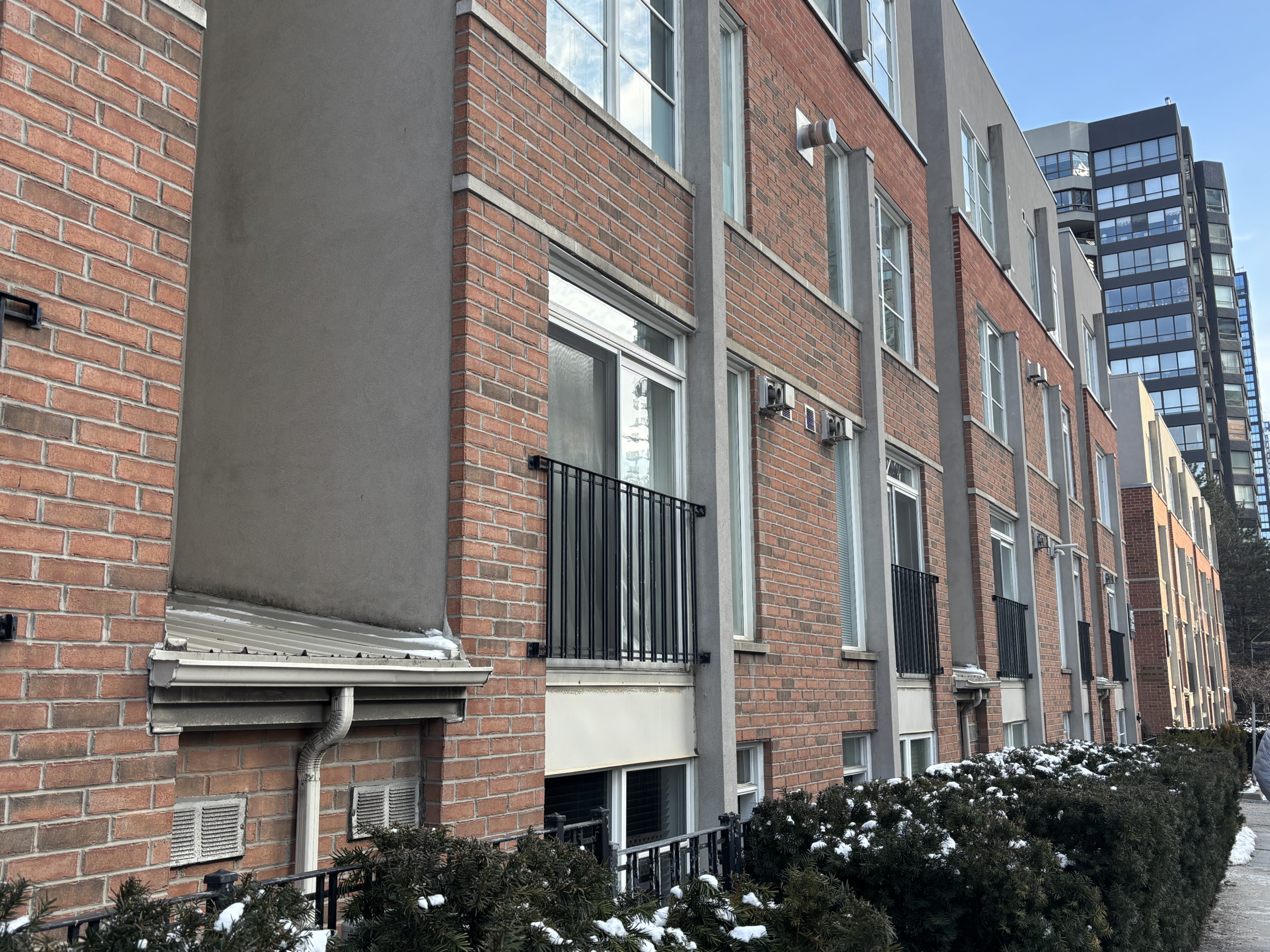
Toronto City Staff suggests changes to the current RentSafeTO to make stricter safety guidelines.
On Feb. 20, 2026, Toronto’s Housing Rights Advisory Committee met to discuss potential changes to its current RentSafeTO program, encouraging feedback to drive the refinements.
RentSafeTO is a bylaw enforcement program that manages maintenance and operational standards, ensuring that apartment building owners meet guidelines.
The report indicates that all purpose-built buildings with three or more storeys, and ten or more units, must register as a RentSafeTO building.
The City’s Policy and Planning Advisor Mitch Thibault and Research Associate Dana Martin presented the pitched changes to the program’s existing evaluation tool, colour-coded signage system and remedial action plan.
Currently, RentSafeTO buildings are evaluated by the City every two years. Buildings that are scored in the bottom 2.5 percentile receive an audit. Apartment building owners that do not address their notices will have their scores temporarily reduced. City Staff complete targeted engagement when a building’s score drops by five per cent for two consecutive months.
Martin said that targeted engagement consists of City Staff speaking with tenants and accepting complaints for in-unit issues. Per targeted engagement, the fee is $3,136.64 charged to the apartment building’s owners.
If a building does not meet standards, orders, notices, fees, remedial actions, as well as other enforcement actions can be applied.
Martin suggests that evaluation category weightings should be altered to accurately support higher risk issues. This includes decreasing moderate risk scoring from two per cent to 1.5 per cent and increasing high-risk from three per cent to 4.5 per cent.
The City is also exploring larger score deductions per violation. This includes two per cent per notice, three per cent per emergency order. They are also considering compounding deductions of 0.25 per cent every month an order is resolved.
The Staff indicated that this ensures scores more accurately reflect building conditions.
The City introduced a newer three-colour signage system that includes red, yellow and green — referring to different levels of need. Red refers to “needs significant improvement,” yellow indicates “needs improvement” and green is “satisfactory.”
Councillor Gord Perks raised concerns about tenants fearing the stigma associated with the different colour signs on their property. He also pointed out that landlords can appeal the violations which slows down the process of improving housing.
Perks also clarified with the presenters that tenants have the right to deny entry to City Staff and contractors.
The presenters encouraged feedback regarding the current RentSafeTO program and its proposed changes to inform a staff report expected in mid-April. A public survey is also available until Feb. 28.
The meeting also reviewed the HousingTO program and heard community members on issues of noise, substance use and internet problems in supportive housing.
Key takeaways
- On Feb. 20, 2026, Toronto’s Housing Rights Advisory Committee met to discuss potential changes to its current RentSafeTO program, encouraging feedback to drive the refinements.
- The City is also exploring larger score deductions per safety violation to ensure scores more accurately reflect building conditions.
- The City proposed a three-colour signage system using red, yellow and green — referring to different levels of building improvement needs.
On-the-ground observations from our documenter, Rouaida nASSIF
When I first moved to Mississauga in 2018, my family and I had to stay at a motel until we were able to find our home. During our stay we met several families like ours, newcomer mothers and their children. Shelters did not have the appropriate facilities to provide for us. We were temporarily part of the 14% of unhoused newcomers in Canada. At the time, the affordable housing we saw in Toronto and Mississauga was in poor condition or required some form of repair. Some units we saw had very old heaters (radiators), floors that had gaps between the wooden planks, and sometimes walls had scratch marks left on them (most likely from moving). A few buildings we saw had unkept hallways with dirty carpets and a musty smell. Overall the buildings were typically older and a bit rundown. I am not sure if RentSafeTO was involved with any of them at the time. I believe it would have been easier for us to find good housing if Mississauga had something similar to RentSafeTO. Our situation was short lived yet very eye opening. This December I attended a tour of the Salvation Army Gateway which included a Q&A portion. I gained insight on how easy it is to become unhoused and the difficulties of finding a transitional home. With limited housing and a growing number of unhoused people, the waitlist for supportive houses can range from one or two years unless dire circumstances, often related to health, lead to prioritization. The process also takes longer when individuals do not have their ID or required documentation, which is not uncommon according to the guides.
CHECK YOUR FACTS
https://housingrightscanada.com/reports/nowhere-to-go-gender-based-violence-and-housing-insecurity-in-ontario/ https://housing-infrastructure.canada.ca/homelessness-sans-abri/reports-rapports/pit-counts-dp-2018-highlights-eng.html#3.5
Documenters:

Meeting notes by Aia Jaber

Meeting documented by Rouaida Nassif