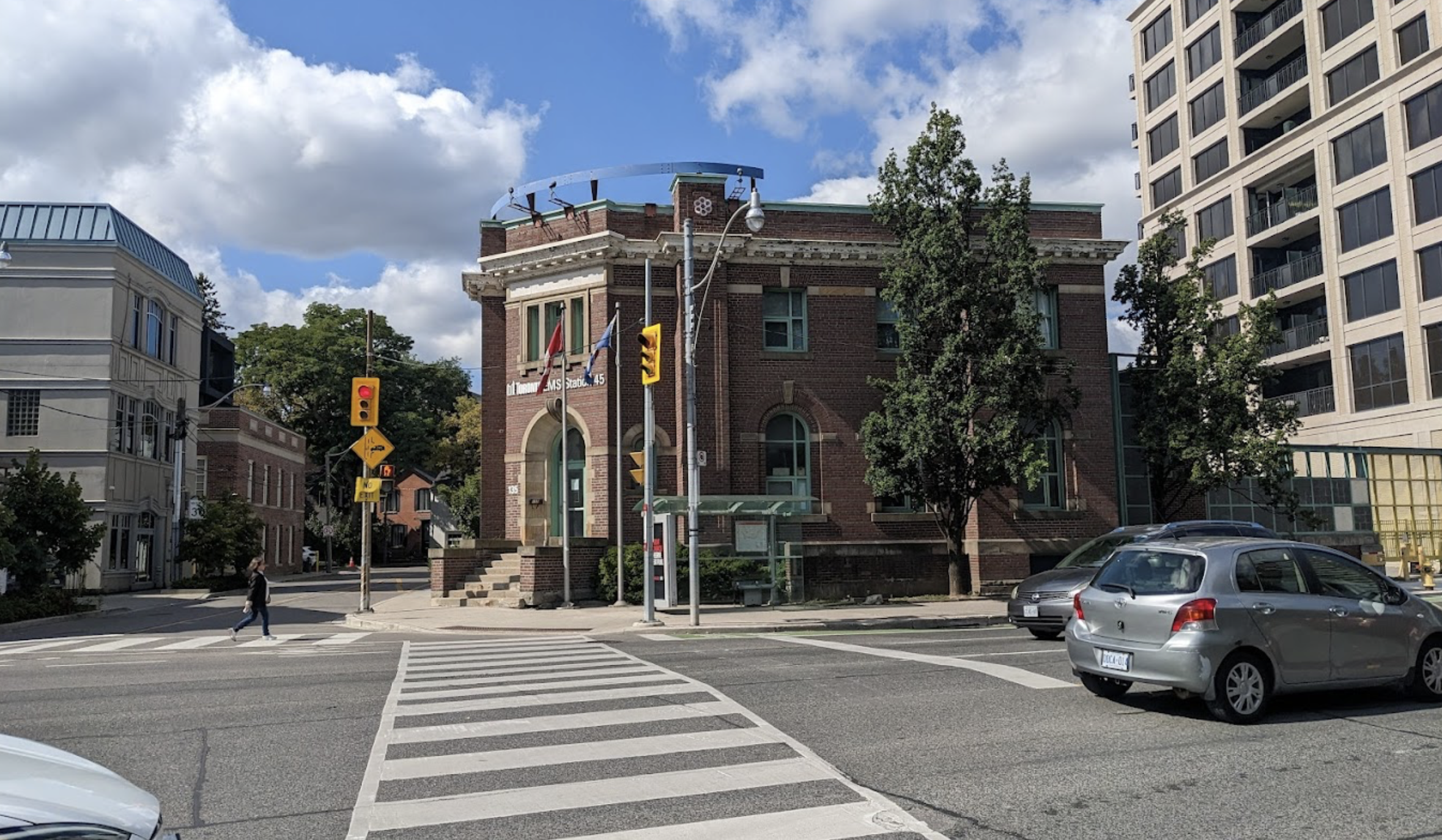
On March 12, the Toronto Preservation Board met to discuss some heritage changes to the City.
Photo by: JC LE/Google Maps.
On March 12, 2026, the Toronto Preservation Board reviewed redevelopment proposals, heritage alterations and a study identifying 88 potential historic properties in the Yorkville area.
Board members voted to recommend that City Council refuse alterations to the designated heritage property at 699 and 707 Yonge St. The site, with two addresses, consists of a three-storey commercial building constructed in 1887.
The Brass Rail Tavern has operated out of the property since 1948.
A redevelopment proposal would construct a 64-storey mixed-use building while maintaining the site’s front as part of the base of the building.
City Heritage Staff recommended the refusal of the alterations, saying the design does not preserve the cultural heritage value of the property.
The board also reviewed a redevelopment proposal impacting properties within the King-Spadina Heritage Conservation District. These include 46 Spadina Ave., 58 Spadina Ave. and 378 Wellington St. W.
Forty-six Spadina Ave. holds the Systems Building — a four-storey industrial building constructed in 1907. The March 26 proposal discusses alterations to the Systems Building, demolition of nearby non-contributing buildings and construction of a mixed-use building with 30-storeys.
The issue will be discussed by the Ontario Land Tribunal but no date has been shared.
The Board also reviewed the final Cultural Heritage Resource Assessment for Bloor-Yorkville that looked at 88 properties with potential cultural heritage value.
City Staff said the report does not designate properties as heritage buildings but, rather, the study identifies those that may require further evaluation.
The study also includes that the Yorkville Village Core could be studied as a potential heritage conservation district.
Yorkville community members expressed both support and concern about the heritage study. Some said they were in favour of it. Paul Bedford, speaking on behalf of the Greater Yorkville Residents Association, thought the report should continue to study the Yorkville Village Core as a potential heritage district.
Colette Koopman, a lawyer, said that property owners are worried about the possible financial implications of heritage designation such as increased maintenance costs and hindrances to future redevelopments.
The board’s recommendations will now move to City Council for further consideration.
Key takeaways
- The City pushed back on a 64-storey tower on Yonge Street.
- Yorkville heritage study proposes 88 properties with potential historic value.
- Property owners and legal professionals warned that heritage status would increase costs.
On-the-ground observations from our documenter, ARIA IPE
As someone who studies and works in Toronto, I’ve seen how the City continues to debate how history should be remembered. When Ryerson University changed its name to Toronto Metropolitan University, some people felt it erased history, while others saw it as correcting it because of Egerton Ryerson’s connection to the residential school system. While that situation involved changing a name rather than preserving a building, it shows how communities regularly reassess how history is represented. In the case of heritage buildings, preserving certain structures can help maintain a visible connection to the past, especially when they represent positive cultural or community history.
CHECK YOUR FACTS
Bloor – Yorkville Cultural Heritage Resource Assessment – Final Report
Full Assessment
Staff Presentation on Bloor – Yorkville Cultural Heritage Resource Assessment
Documenters:

Meeting notes by Aia Jaber

Meeting documented by Aria Ipe